

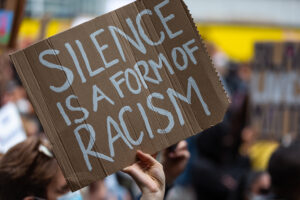
 If you think that racism in America is no longer a problem, I urge you to think again. The Black experience in the United States has been and often continues to be, one of fear, oppression, and violence. While he was being handcuffed after being forced to the ground during a traffic stop that had quickly and unnecessarily escalated, Tyreek Hill, a wide receiver for the Miami Dolphins, summed up the experience as, “Just being Black in America, bro,”
Racial profiling and discriminatory actions aren’t limited to law enforcement but impact all areas of life. The White House recently released an Issue Brief on “Racial Discrimination in America,” which points out that “while many gaps have improved over time, significant racial disparities exist in various aspects of American life, such as neighborhood quality (which affects the childhood environment), employment in adulthood, and wealth accumulation.”
The Brief further states, “Research shows the persistence of differential treatment by race in access to housing, employment, and mortgage or business loans—even in settings where there are no differences across groups other than race (for example, job applicants with identical resumés but different names), or settings where no other factors would influence outcomes—indicating that discrimination still exists today and plays a role in explaining current racial gaps.”
Those gaps are also addressed in “Fighting the 400-Year Pandemic: Racism Against Black People in Organizations” in the Journal of Business and Psychology, which likens racism to a plague. “In 2020, we saw intense moments that highlighted the stark anti-Black racism and racial inequity in America. Namely, the murder of George Floyd coupled with the disproportionate levels of negative outcomes from the COVID-19 pandemic affecting Black people in the USA. These instances called attention to the considerable racial inequality in US society and reminded many people that racism seeps throughout all facets of life.”
From the visuals of the uprising on the streets of Ferguson, Missouri, and subsequently across the nation to the slights and barbs of the grocery store cashier, landlord, or hiring manager, racism is everywhere. It has even seeped into our political discourse, proving that not one person of color is immune – not even former President Barack Obama or Kamala Harris, our current Vice President and the Democratic nominee.
In a recent debate, former President Trump’s comments about Haitians eating the dogs and cats in Springfield, Ohio, prompted hilarious conversations and some brilliant social media memes. It also illustrated the deepening divisions in our discourse and the continued effectiveness of fearmongering – something white politicians have used against immigrants of color for centuries – which can lead to increasing racial violence.
“If you make it seem like a group is savage or uncivilized, it makes it a lot easier to scapegoat and enact harmful laws against [them],” Anthony Ocampo, a professor of sociology at California State Polytechnic University, Pomona, recently said to a reporter from The Guardian.
Mr. Trump also seems to be relying on an old political tactic of exoticizing nonwhite candidates. It started with his attacks on Barack Obama and the continued questioning on his birthplace and the legitimacy of his birth certificate and continues today as he questions Harris’s racial identity. While Trump questioning Harris’s identity may seem shocking (since she graduated from Howard, and is a member of Alpha Kappa Alpha, the first Black sorority), it was hardly surprising given his long history of blatantly racist comments.
Lisa Lerer and Maya King, who reported on the National Association of Black Journalists Conference for the New York Times, wrote that the former president has a history of, “Using race to pit groups of Americans against one another, amplifying a strain of racial politics that has risen as a generation of Black politicians has ascended.”
They also added, “Questioning how much a Black woman truly belongs to Black America was particularly incendiary. And it evoked an ugly history in this country, in which white America has often declared the racial categories that define citizens and sought to determine who gets to call themselves what.”
Mr. Obama ran as a candidate whose success would signal the arrival of a post-racial America. However, 13 years after his first presidential campaign, the fears and disquiet invoked during that time have escalated. The Brennan Center for Justice reprinted an article by Theodore R. Johnson, who wrote that race is not a minor part or even a distraction from the broader debate about the future of our democracy.
“There is a real sense that the parties are further apart on questions of race today than they have been for some time—each side being pulled to the poles. But the truth is more complicated,” Johnson wrote. “The yawning gap between the parties is not, as is often suggested because Republicans have become more racist, and Democrats have become more woke; it is because the left has become more progressive on racial inequality while the right has fortified its pre-existing position.”
The Pew Research Center writes that there are wide differences in how Americans view the country’s progress toward racial and ethnic equality across demographic groups, especially after “the nationwide protests (that) erupted after George Floyd’s murder at the hands of the Minneapolis police. The public is deeply divided over how far the nation has progressed in addressing racial inequality – and how much further it needs to go.”
We do have a long way to go. First of all, I recognize the privilege that I, as a white woman in America, inherently have and the fact that racism is not part of my everyday experience. I have never had to speak to my children about the need to be careful about where they go or what they do because of the color of their skin. I have never been denied housing, or a job or promotion, or been questioned about the legitimacy of my citizenship or because of it, and I feel that now, in 2024, no one else should be either. No woman should be denied access to the same opportunities, safety, and dignity that I have always taken for granted and no mother should have to hear that her child was gunned down and their actions were misinterpreted because they were Black.
In How to Be an Antiracist, Ibram X. Kendi describes race and racism as power constructs of the modern world and points out the fact that racism is not even 600 years old. “Racism is one of the fastest spreading and most fatal cancers humanity has ever known. It is hard to find a place where its cancer cells are not dividing and multiplying. There is nothing I see in our world today, in our history, giving me hope that one day antiracists will win the fight, that one day the flag of antiracism will fly over a world of equity. What gives me hope is a simple truism. Once we lose hope, we are guaranteed to lose. But if we ignore the odds and fight to create an antiracist world, then we give humanity a chance to one day survive, a chance to live in communion, a chance to live forever free.”
As racial prejudice, racist tropes, comments, and divisions become a larger and often accepted part of our political discourse – amplified by the media – racism will gain a stronger foothold in our schools, neighborhoods, workplaces, and everywhere that we call home. That is not the world we want our children to inherit, surely. That is not okay. We need to recognize the pervasive impact of racism, and the deep injustices it creates at every level. We must do everything in our power to make sure that no person – man, woman, or child – is forced to live in fear or face discrimination because of the color of their skin. We must do better. We can do better. Not just in thought, but also in word and deed.