

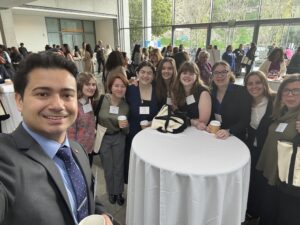
 As Women’s History Month drew to a close, Women Connect4Good Team Leader Melissa Miller Young joined over 500 thought leaders for the 14th Annual Report on the Status of Women and Girls in California™. Held by the Center for Advancement of Women at Mount Saint Mary’s University (MSMU) at the Skirball Cultural Center, the event brought together women and men from all walks of life, fostering conversation and inspiring action to address inequalities and gender gaps in California and beyond.
For over a decade, the Report has served as a valuable resource for advocates, business leaders, elected officials, and engaged citizens. This year, researchers conducted an in-depth exploration of the representation of women and girls in the arts — a crucial industry that shapes cultural narratives and societal perceptions. The Report states, “Throughout history, the arts have been a powerful medium for expressing ideas, influencing social change, and reflecting the diversity of human experiences. However, women and girls have often been marginalized, underrepresented, or misrepresented in many artistic forms, from literature and visual arts to film and music. This lack of representation not only limits the visibility of women’s perspectives but also perpetuates stereotypes and reinforces gender inequalities.”
So, why, at a time like this, should we focus on the impact the arts have on the lives of women and girls in California? “Because,” MSMU President Ann McElaney-Johnson, PhD, wrote, “This is the type of moment the arts and humanities are meant for.”
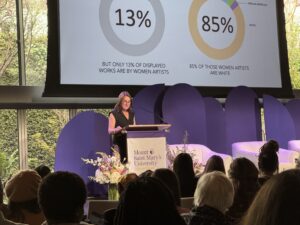 “The art we make and the cultures we preserve are stories we choose to share with each other. And these stories must include California’s women and girls,” McElaney-Johnson said. “The stories of our lives and the world as we encounter it. Stories about who we are and who we aspire to be as individuals and as communities. These stories also help us see possibility — and allow young women to see themselves in roles they might never have considered before.”
Reinforcing the idea that you have to “See it to be it,” MSMU Vice President for Strategic Initiatives and Partnerships Krishauna Hines-Gaither, PhD, pointed out that while art and cultural productions add a resounding $290.3 billion in value to the California economy, they also, “influence how we see ourselves and exemplify what we value. When we experience the stories of those unlike ourselves, we can begin to bridge our differences, too.”
Striking a chord of urgency, the Report states, “As we continue to strive for a more inclusive and equitable society, ensuring the representation of women and girls in the arts is paramount. While more women are in leadership positions in cultural institutions in California and across the country now than ever before, it will take time to see true change.”
In Section One: The Arts and Culture Workforce, researchers found that while women are well represented in decision-making roles, the works of women artists are often missing from public view – as in, only 14% of display works are by women artists, despite the fact that women make up about 46% of artists in the U.S. In the world of TV and film, only about one in three speaking characters onscreen is a woman. However, when women are in key positions behind the scenes, there are more women of substance displayed onscreen.
Section Two: Education and the Arts shares a body of evidence supporting the fact that children exposed to the arts develop enhanced social skills and perform better academically than children who are not exposed to the arts. However, despite the benefits, finding room and funding in a crowded curriculum – especially in under-resourced schools – is often easier said than done.
 Section Three: Persistent Issues Faced by Women examines overall earnings and the pay gap between women and men. It highlights that over the past decade, the wage gap has narrowed for most women but remains significant for full-time working Black women. Safety and violence against women are also examined, with researchers finding that approximately 8% of California women reported being victims of sexual harassment or assault, while an estimated 6% had been sexually abused by an intimate partner. The assessment of emotional well-being revealed that women are not only more likely to be diagnosed with depression (21% compared to 13%) but also that 56% of women say financial worries negatively affect their well-being. Those feelings often begin early, with over half (52%) of 12th-grade girls reporting chronic feelings of sadness and hopelessness and 41% of girls identifying with those feelings as early as the seventh grade.
In examining the Report, regarding not only the portrayal of women in California but also the extent to which women’s contributions are valued, Dr. Hines-Gaither wrote, “The majority of the art we consume is still created through the lens of white males, and when women are represented, they tend to be white women — on screen, in our museums, at historic sites, and through public art. When the arts produce limited and patterned images of women across our cultural landscape, we see direct connections to the persistent inequities that women face throughout their lives — such as in their earnings, education, mental health, and overall well-being.” Ultimately, Dr. Hines-Gaither contends that the arts serve as an antidote and are something that all women in California should have access to.
This year’s report also provides updates on data researchers have shared over the past decade regarding the status of women and girls in key areas in California. It includes the ongoing challenges they face, such as the earnings gap, health and emotional well-being, and safety issues.
She Is Not a Footnote
Underrepresentation of women isn’t just an issue for women and girls in California, it impacts us all, and Frédérique Irwin, President & CEO of the National Women’s History Museum (NWHM), believes when more women hold decision-making roles across industries, it harnesses the full strength, leadership, and creativity of all people across the U.S. In fact, Irwin contends that “increased representation leads to better decisions for everyone and drives progress towards closing the gender parity gap.”
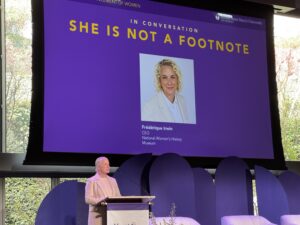 Citing NWHM’s new Young Women and Girls’ Aspiration Report, Irwin took the stage and shared a grim reality: Despite recent progress, systemic barriers in economic opportunity, education, health care, and politics still block young women and girls’ path to success. The Report is the first initiative of the Museum’s “She Is Not a Footnote” cause campaign. It combines the expertise of the Museum with the research of the Center for the Advancement of Women at Mount Saint Mary’s University, the U.S. Census Bureau’s American Community Survey (ACS) 2023, and DoSomething Strategic, which conducted a nationwide survey of young women to capture their perspectives on gender equity.
As the campaign’s first initiative, the Aspiration Report reveals insights from young women across the country on the challenges they face in education, the workforce, healthcare, and politics—the very sectors shaping our future. Just as important, it shares their ideas for driving meaningful change and expanding opportunities for the next generation.
With nearly 22 million girls and young women in the U.S. today, Irwin contends that their success is America’s success, saying, “No matter what issue you care about—economic growth, innovation, healthcare, education, or national security—if half the population is sidelined, we are setting ourselves up for failure. The challenges of today and tomorrow demand all of the talent, leadership, and creativity we have. Yet, women remain underrepresented in every arena that shapes our future. This isn’t just a women’s issue—it’s a national issue.”
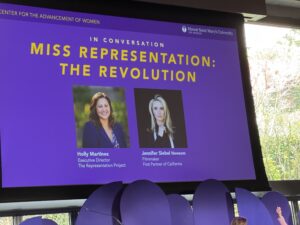 The Representation Project
Jennifer Siebel Newsom, First Partner of California and Founder of The Representation Project, and the organization’s Executive Director Holly Martinez, were also on hand to discuss the powerful follow-up to the acclaimed film Miss Representation. Their latest film, Miss Representation: The Revolution, continues the theme of representation and exposes tech-facilitated gender-based violence and the growing backlash against women’s progress, mental health, and agency. Set to premiere in 2025, the film looks at how technology raises the stakes with women’s safety and lives on the line and explores the dangers of the digital world women and girls today must navigate where online violence, often sexual in nature, goes unchecked and has become normalized. This dangerous new reality has led to a surge of sexist social media attacks that jeopardize the safety, mental health, and well-being of women and girls and calls for a united wave of feminism anchored in partnership to right the ship.
“Every new piece of technology, in one way or another, is used against women and girls. And that’s what we’ve been seeing, right?” Siebel Newsom asked. “We have to pay attention because a thriving democracy requires women to have voices and stand in their power. And what’s going on in our country right now? We’re all being silenced. That’s happening constantly. Our country is in jeopardy because we are not able to use our voices in ways that our country needs us to use our voices. The obstacles that threaten are very real, and the online world is completely parallel to and, in effect, as valid as the real world. We have to take it seriously. And the tech companies have no interest in protecting us.”
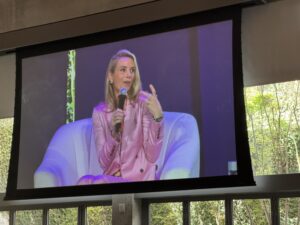 Reminding attendees that we are in this together and that partnership is the only way forward, Siebel Newsom added, “We have to be strategic, and we have to collaborate across every perceived difference. The patriarchy wants us to fight each other based on race, ethnicity, class, and sexual orientation. They are really good at turning us against one another, and that’s a no-win situation. We will never make any progress unless we are arm in arm. There has to be transparency, there has to be accountability, and there has to be human connection. ”
Closing with the importance of representation, Martinez urged attendees to pay attention to the details in this year’s Report and pointed out that the flip side of this coin, of course, is that — with the right approach — technology, art, and entertainment, can be part of the solution to ending sexual violence in our society. “We want women to feel empowered by the depictions of themselves that they see in our arts and entertainment.”
The Report
 In conclusion, the Report’s authors wrote, “Women’s underrepresentation in the arts is not incidental to the gender inequities that persist in our world — it is a root cause of their persistence. You can see that each year within the very pages of this Report. So many of the inequities we track — from earnings and wealth to health and safety — stem from how (and how often) we see women represented (and misrepresented) in our arts and culture.
Women must be part of the creative process and cultural landscape to ensure that the full spectrum of women’s stories are faithfully represented in the arts and humanities. Otherwise, stories are told about us, and our lived experiences do not inform those stories and, therefore, do not inform the world around us. That shortchanges women, of course, as well as the girls who look up to us. It also shortchanges our economy and the vitality of our communities.”
Until we become the authors of our own stories, with true representation at all levels, change will remain a distant mirage, always out of reach. Go to the MSMU website to download your copy of the Report or learn more about this year’s Status of Women and Girls in California event. More perspectives from the Report will appear in future blog posts.