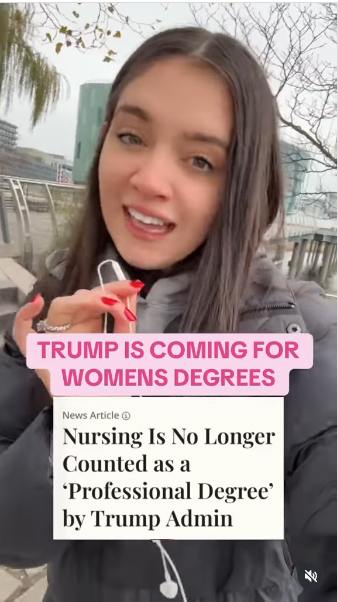

Guest Post by Haley Lickstein, CEO, Haley Lickstein Media and Women Connect4Good Board Member
Repost from Substack.
Earlier this month, the Trump Department of Education did something huge that almost no one noticed: they rewrote which graduate programs count as “professional degrees.” It sounds like bureaucratic housekeeping, but it’s actually one of the most consequential attacks on women’s economic independence we’ve seen in years.
Here’s what happened.
This summer, Trump signed a bill that capped how much graduate students can borrow and eliminated the Grad PLUS loan program entirely. The only way certain degrees could still qualify for higher loan limits was if they were labeled “professional.” So a committee met to decide which programs would make the cut.
Last week, the Department of Education’s Reimagining and Improving Student Education (RISE) Committee reached preliminary consensus on a proposed definition of “professional degree programs” under the One Big Beautiful Bill Act (OBBBA).
By the end of negotiations, the Department of Education agreed to recognize just eleven fields — medicine, dentistry, law, pharmacy, theology, and a few others — as “professional degrees.” They made the very specific choice of excluding nursing, education, social work, public health, counseling, occupational therapy, and architecture.
And here’s the part you’re not supposed to notice: the excluded degrees are overwhelmingly held by women. In some of these fields, 80–90% of graduates are women. The newly protected degrees? Much more male-dominated, and often much higher-paid.
So what does this mean in the real world?
It means women entering teaching, nursing, mental health care, or social work — the fields that literally hold American communities together — will suddenly be limited to much smaller loans, with fewer options to cover the cost of their required clinical hours, licensing, and training. Many simply won’t be able to afford these degrees at all. And at a moment when the U.S. is already short hundreds of thousands of nurses and teachers, these restrictions make the pipeline even thinner.
This is not an accident. It aligns perfectly with a broader pattern: abortion bans, attacks on contraception, fights to weaken no-fault divorce, rhetoric romanticizing “traditional roles,” and now a federal policy that quietly makes it harder for women to enter the workforce in the first place.
You don’t have to tell women to stay home if you can financially choke off their access to the degrees that give them stable careers.
That’s what this is: an economic strategy dressed up as regulation. A way to shrink women’s independence by shrinking the professional paths available to them. A way to reduce their public power by limiting who gets to become a nurse, an educator, a counselor, a social worker — the same women who have long been the backbone of community organizing and pro-democracy coalitions.
The Department of Education is expected to issue a Notice of Proposed Rulemaking in the coming weeks, which will open a 30-day public comment period. You must use this time to be vocal on this as it will shape women’s lives for decades.