

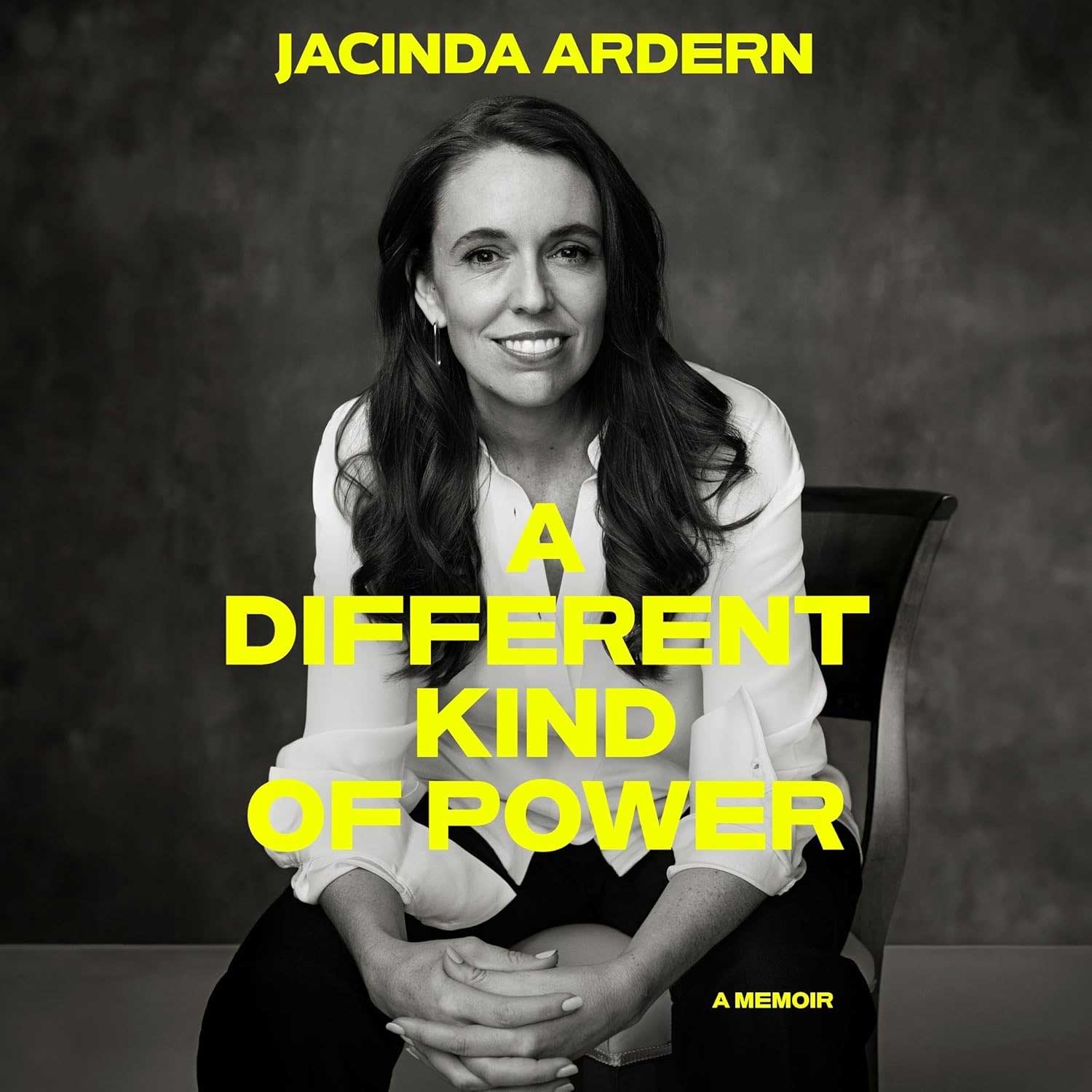
 Jacinda Ardern’s memoir, A Different Kind of Power, shows her to be both a reluctant politician and a tailor-made female leader with a passion for change. Most women who enter politics, at whatever level, want to help people, make their communities safer, improve their children’s access to education, and more. The Right Honourable Dame Jacinda Arden, the fortieth prime minister of New Zealand, was fueled by all of that, especially the concerns regarding children. After hearing a grandfather talk about his struggles to care for his grandchild, she wanted to create systemic change to support him and wondered what it would be like to be an MP and have a vote. She also believed that if policies could fix shortages for children (food, education, caretaking), other problems like the overpopulation of prisons, violent crime, etc. would also be fixed.
Ardern’s reluctance was born of self-doubt, thinking she was too thin-skinned to survive, and not matching people’s image of a politician. When she asked school children to imagine a politician, they said, “male,” “old,” “gray.” When she asked about this imaginary person’s tone of voice, they said, “Confident.” “Angry.” “Aggressive.” This was what they saw in the media, and they repeated it over and over. She knew she could never be that kind of leader and that she couldn’t choose between being a good politician and her vision of a good person. She accepted the criticism and went on waging a different kind of power.
By then, she was an MP. She got elected from “the list.” Ardern briefly explains New Zealand’s form of government and means of electing parliament. It has a mixed-member proportional voting system (MMP). Everyone gets two votes: one for the candidate running in their district and one to choose the majority party. After the votes are counted, the party with more votes gets to choose from the party list of non-designated candidates. By agreeing to be on the list, she convinced herself that she was running without really running. She also got to work on policies close to her heart: children’s poverty and health including investigations into why they died when being protected by the state, for example. Ardern also got to rise within the party ranks. When Labour finally won, she also won as an MP with her own constituency, then rose to Deputy Head when another MP retired. Finally, she was positioned to run for Prime Minister and head of the party.
Before taking office, Ardern said, “I want this government to feel different. I want people to feel that it’s open, that it’s listening, and that it’s going to bring kindness back.” She admits that kindness is a child’s word, but that it represented everything important to her. She had seen it give people hope, change minds and transform lives. She was sure that almost nothing else had the power of kindness and she pledged that it would be her guiding principle no matter what.
Ardern’s chapters about her years as a Prime Minister, also include her pregnancy, struggling to prepare breast milk for her infant while on international flights, and receiving team childcare help from her partner Clarke, her mother, Clarke’s parents, and even personal security guards, while “Mum did her important job.” For those who may not remember, those days included the Christchurch shooting in which an Australian immigrant murdered 51 Muslims after final prayers, plunging New Zealanders into national grief and spurring a national ban on assault weapons while leaving access to hunting firearms intact. This disaster was followed by the COVID pandemic, which Ardern navigated by closing the borders, through limited shutdowns, and 90% vaccine distribution (the highest of any developed nation). Kindness also prevailed. When protestors screamed angrily in her face about government intrusion, she tried to remember that the person spewing hate could be one of the 20,000 lives their policies had saved. The “shaky island” of New Zealand also had a volcano eruption on Whakaari/White Island, after which Ardern went, visited with survivors and thanked the first responders who had risked their lives in horrendous conditions. Bothered by negative posts about her capitalizing on photo-ops hugging people, she shook it off thinking that she would choose to be human over letting these insensitive criticisms affect her actions.
Other notable events during Ardern’s five years as Prime Minister are the $1.9 billion investment into mental health over four years in the “Well-being Budget,” where she insisted on reaching a goal of zero suicides in the future. If that seems like an impossible dream, imagine the “Child and Youth Wellbeing Strategy,” which was a plan to ensure that “every New Zealand child could live in a home where they were safe and loved and have what they needed to thrive.” To make sure the plan included everything they needed, they consulted experts, including children, by sending thousands of postcards asking them what they needed. The children answered with hand-written words and pictures, and Ardern read them all. Her stories of the adventure of attending the launch at an intermediate school where 700 children energetically performed a native dance, haka, and all of the interruptions and concerns of a mother with a small child in tow make this book relatable and a joy to read.
Other relatable moments and inspirational quotes for copying to those workspace Post-its pepper her life story. When she asked a fellow MP how to toughen up, he told her if she stopped caring and lost her empathy, she would quit being good at her job. As she watched the National Party undo programs that Labour created, she realized that the problem wasn’t making change, but making it stick. Her realization that “the power of opposition was to drum up opposition” is something that we all could benefit from, and her view from “inside the pandemic” sparked a great quote, “Leadership is a test for which you can only partially prepare.”
To get the full impact of Ardern’s story and insights into what makes a good leader, read this book. Use it as a mentor if you’re looking for guidance for your own trajectory as a leader. Use it to supply hope that there truly could be kindness in politics. Use it to remember that we’re all human and it’s our responsibility to examine our perceived faults and strengths and use both to be the best humans we can be. In the end Ardern decided that she did her best, and her reward is that she felt no matter what she did, she helped someone every day. That’s something we can all strive for—help someone every day and do our best. That is how we can all engage a different kind of power and lead by example.