

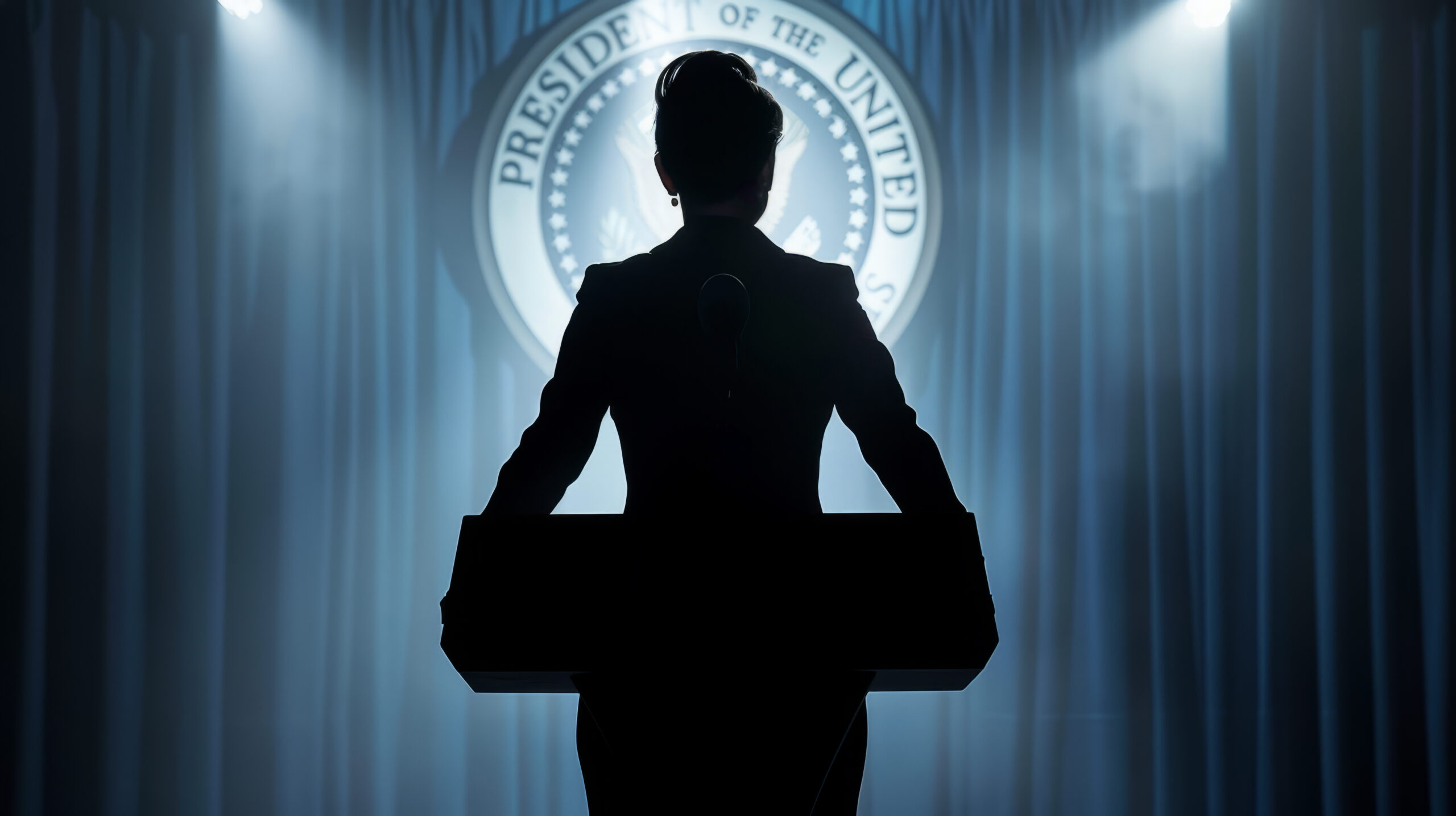
While we still haven’t elected a woman to be president in the US, we need to keep the faith and remember that every single advancement women have made has come with its share of setbacks. Progress happens gradually, often by degrees, and it is certainly not linear. With yet another man headed to the Oval Office, so little representation in the halls of power, government, and industry, and with women earning from 52 cents to 80 cents to every man’s dollar (depending on race and ethnicity), it’s amazing that anyone would think we have gender equality. But they do. In fact, one post-election campaign survey showed that 54% of respondents think women already have legal equality (the Equal Rights Amendment) and protections as part of the Constitution. We do not.
In her film, 50/50 of Women + Power, Tiffany Shlain expressed amazement that there were 50 women heads of state worldwide. She asked others in the film how many women they thought were presidents or prime ministers. Most answered five or six and were equally amazed to hear that there were 50. The year was 2016, and the film was released just two months before the election, where she watched the first woman candidate from a major political party win the popular vote. Although the popular vote did not align with the Electoral College to make Hillary Clinton our first woman president, it did set a precedent. It showed other women what was possible, and in 2020, six women ran for president, the greatest number ever.
Those six women were senators Elizabeth Warren, Amy Klobuchar, Kristen Gillibrand, Kamala Harris, Representative Tulsi Gabbard, and author, lecturer, entrepreneur, and activist Marianne Williamson. NBC News Correspondent and author Ali Vitali covered the election and wrote Electable: Why America Hasn’t Put a Women in The White House….Yet, summarizing her observations about the responses to women candidates. Vitali answers the main “why” in her book simply as “sexism” but says that the answer is more complicated. Part of it is because the Constitution still does not include women, except in the 19th Amendment, giving women the right to vote. The founders’ words remain in place for equality with “all men are created equal,” despite Abigail Adams famous plea for her husband to change that. (Read her letter in the historical perspective below).
Another huge “why” is the voters themselves—most of whom see a man, mostly white and older, and think “President.” He really doesn’t have to have much, if any, experience. Vitali highlighted Senator Amy Klobuchar’s jabs at Mayor Pete Buttigieg for being elected to only one office, while she won elections in red and purple counties and passed over a hundred bills as the lead Democrat during her time in Washington. She called out and challenged the suit-clad, tall, male presidential image, saying what mattered is “if you’re smart, if you’re competent, and if you get things done.” During a debate, Klobuchar said, “I govern both with my head and my heart.” Like all the women candidates in 2016 and even in 2024, she fought against those who think a woman couldn’t look presidential and commented that she follows former Senator Barbara Mikulski’s lead about what a senator looked like, saying, “You want to know what a president looks like. You’re looking at it.”
Representation for women continues to advance at a snail’s pace, and that’s without any setbacks. Although women represent 51% of the population, issues about family leave, healthcare, and reproductive care are considered niche issues, not relating to the whole population. Women legislators collaborate to increase their power to get laws passed to benefit their constituents. Only 60% of registered voters voted in the 2024 election. Why? Did they not like the choices? Did they feel too uninformed? Did they think it didn’t matter?
One thing is certain, voters in the US still have a bias against electing a woman for president. Frédérique Campagne Irwin said that after the election, the National Women’s History Museum ran a survey with a single question, “Can you imagine having a woman president in the US?” Only 22% of the respondents said yes. And no, you didn’t read that wrong, 22 percent.
Yet, the 2024 election was very close, despite claims of an “unprecedented and powerful mandate.” Peter Baker reported on November 22—with some votes still being counted—The New York Times showed Trump winning the popular vote with 49.988 percent as of Friday night, and it “appears likely to fall below that once the final results are in, meaning he would not capture a majority. Another count used by CNN and other outlets shows him winning 49.9 percent.” That means, either way, his margin over Vice President Kamala d was only about 1.6 percentage points (and could ultimately end up around 1.5 points), and that means the margin of victory not a mandate, but instead is the third smallest margin of victory since 1888, illustrating that we’re getting closer, and closer to seeing a woman occupy the Oval Office.
We should look at our wins, not our losses, and treat this moment as one where we roll up our sleeves and get to work. Cultural change can be glacial, especially if—by attempting to push the barriers—you are called dehumanizing names. But women are tough, and together, we can be tougher. We need to read our history and follow in the footsteps of the amazing women who forged the paths that we follow. It’s time to be resilient, analyze this setback, and not sit back and allow the headway we have made to be pushed back out of the reach of equality. Let’s instead focus on abundance and look for guidance from other countries that have elected and enjoyed the benefits of women leaders.
Historical Perspective
March 31, 1776
Abigail Adams writes to John Adams, founding father, upon talks of the Constitution, begging him to consider: “Remember the ladies and be more generous and favorable to them than your ancestors. Do not put such unlimited power into the hands of the husbands. Remember, all men would be tyrants if they could. If particular care and attention is not paid to the ladies, we are determined to foment a rebellion and will not hold ourselves bound by any laws in which we have no voice or representation.”