

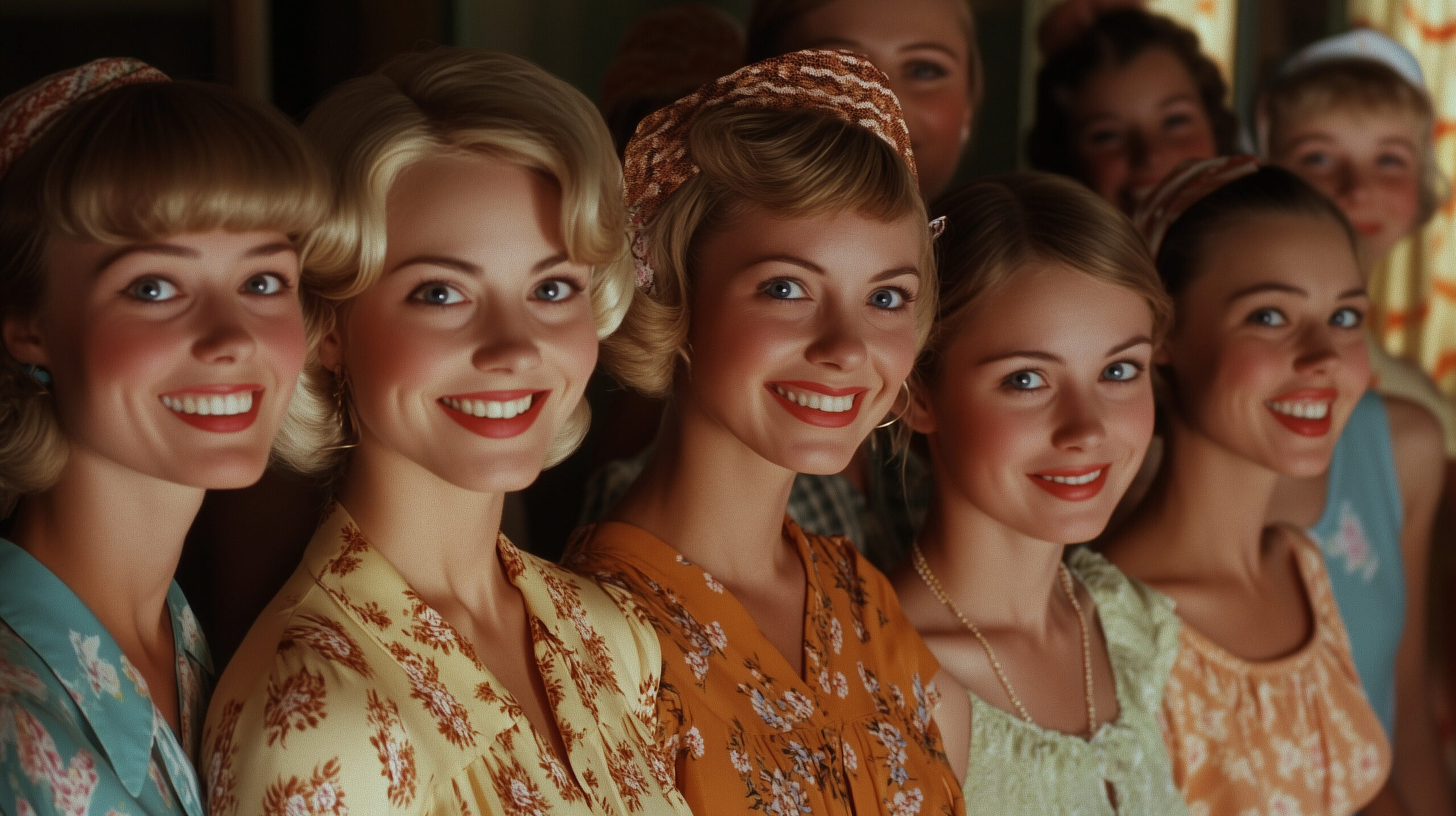
 The social media memes declaring a wave of #tradwives in opposition to #girlboss have become normalized, which means many people accept these categories as either something to aspire to or hate. This is just one of the cultural labels that pits women against each other according to the life they live instead of bringing us together as a force for positive change.
If you’ve somehow missed the dialogue: girl bosses harken back to the Lean In era when women first talked about claiming their seat at the table—but along with that came biases against childless women and those who pursued career advancement. Tradwives, or traditional wives, are the new iteration of the Ozzie and Harriet/June Cleaver ideal of wives living happily at home, while trad husbands provide and sustain the family on one income. It goes beyond stay-at-home moms as a label that fits more snugly into social memes to draw judgment for or against, and it points to their role as wives rather than mothers.
Even though social influencers make this look attractive, for most it is only sustainable as an ideal. One glaring problem with this scenario is the impossibility of financing this middle-class life in today’s economy. Michael Greene explained the lie in using the US poverty line as a benchmark for the middle class in “The Valley of Death: Why $100,000 Is the New Poverty” for The Free Press.
Greene wrote that Mollie Orshansky, an economist at the Social Security Administration, observed in 1963 that families spent roughly one-third of their income on groceries. She multiplied that number by three to establish a poverty line (a crisis threshold) and presented her findings in 1965, when housing was cheap; healthcare was provided by employers; childcare didn’t exist; and cars and college were comparably affordable.
Greene details today’s stark reality: “But everything changed between 1963 and 2024. Housing costs exploded. Healthcare became the largest household expense for many families. Employer coverage shrank while deductibles grew. Childcare became a market, and that market became ruinously expensive. College went from affordable to crippling.” His bottom line is that instead of $31,200 for a family of four, the crisis threshold is close to $140,000.”
Struggling tradwives may see becoming girlbosses as an attractive financial alternative. But the real labor—cooking, cleaning, and managing a household—doesn’t fit the cultural image. And the social-media meme culture is all about image. What is really going on for some women is revealed in Tia Levings memoir, A Well-Trained Wife.
Levings was raised in a moderate Christian environment but was indoctrinated into a fundamentalist sect in her teens, where she was groomed as a traditional wife and the “quiverfull” doctrine, which advocates for having an unlimited number of children. Levings describes the restrictive box for men and women in this patriarchal environment, where they are taught that suffering is Christ-like and will earn them a place in heaven. Young men are expected to behave as men— strong, silent, and invulnerable. The simmering anger and frustration for young men in this box result in abuse and violence toward their wives, who are expected to serve and obey.
This stereotypical bias is real for many men in the culture of patriarchy. Tony Porter created A Call to Men to help men understand the “Man Box,” his term for a set of social rules that teaches boys they are strong, and girls are weak, that women have less value, and that men can own women. The system boxes men off, preventing them from developing emotional intelligence and dealing with trauma in healthy ways. In his podcast interview with Dr. Nancy, Porter reveals that he founded A Call to Men when he realized that very few men abuse women, but the rest of us give them permission by normalizing it by not speaking out.
Kimya Motley, Program Director for A Call to Men, joined Porter on the podcast and told her own story of being shot by her husband. She educates parents, urging them to “give your sons permission to be human, to be tender, to ask for help, to cry, and to feel fear. Pay attention to the lessons you’re teaching your children. Don’t raise them to perpetrate violence or accept abuse as natural.”
Accepting abuse as natural and normalizing boxes that keep us separated into “us and them” camps keep us from living as whole humans. In her book, In This Together, Dr. Nancy wrote that biases are shortcuts for learning behaviors to fit into our culture, but they are also what hold us back. This is not healthy for anyone—men or women.
What is most unhealthy is the labeling itself. Labels have become a weapon to divide us—to attempt to cancel some cultures and promote others. We can choose to create and tell our own stories. In Leading Women, co-author Bridget Cook-Burch tells her story about accepting sexual abuse from a client because she feared she could not support her children as a single mom. It took a leap of faith to fire her client and turn to friends, where she could write a new story as a co-owner of a trucking company, working with and managing both men and women free of fear and toxic degradation.
What story are you telling? Are you connecting for good, supporting others, and accepting help yourself? In her recent podcast, filmmaker Asha Dahya said that we must change the culture to create lasting change. Let’s normalize a new culture, a safe place, that enables people to work together, live together, and thrive equally in a win-win world.